Arkreen's November 2024 Token Burn: A Commitment to Sustainability
Sunday, December 8, 2024 12:00 AM
2,830
Arkreen's November 2024 Token Burn: A Commitment to Sustainability cover

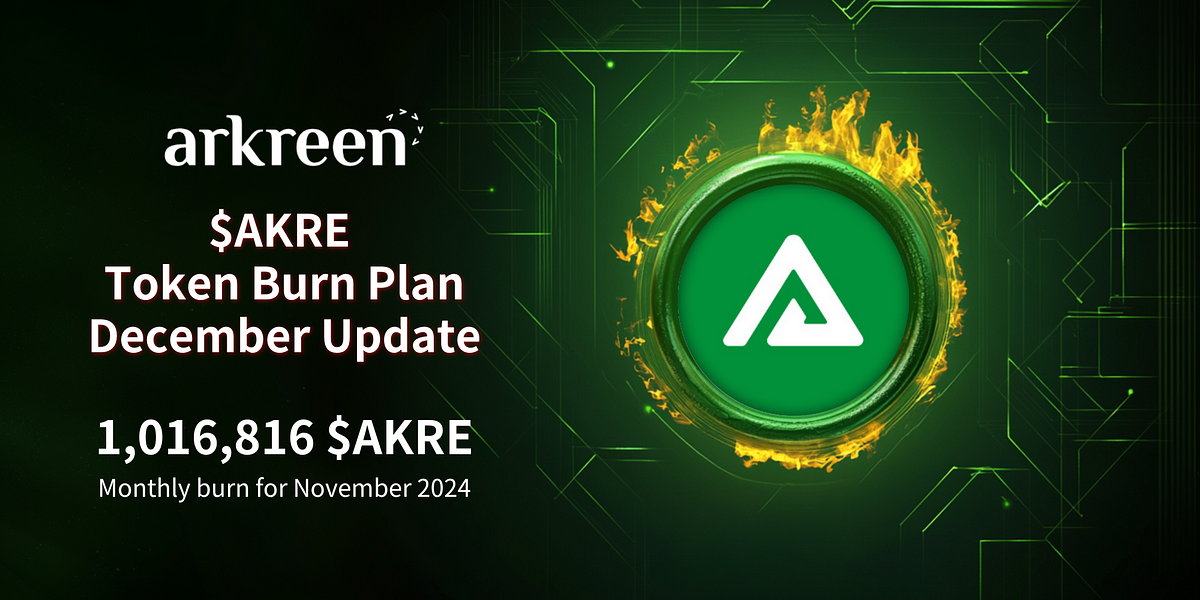
Arkreen is making significant strides in promoting transparency and community trust through its monthly token burn initiative. For November 2024, the total burn of $AKRE tokens reached 1,016,816.02, reflecting the company’s commitment to sustainability and accountability. The process involves a service fee for issuing tokenized Renewable Energy Certificates (ART), with each ART equating to 1000 $AKRE. In November, Arkreen issued 370.91467 ART, collecting fees amounting to 370,914.67 $AKRE. Of this, 296,731.74 $AKRE was allocated for burning, while 74,182.93 $AKRE was directed to the treasury, enhancing the ecosystem’s financial health.

In addition to the issuance fees, November 2024 marked a pivotal moment for Arkreen with the introduction of service fees for on-chain ART offsets. This new initiative allocates 80% of the collected fees for token burns, reinforcing the deflationary model of the ecosystem. Each ART offset incurs a fee of 1 ART = 1000 $AKRE, with the Arkreen Foundation currently sponsoring these fees during the smart contract upgrade. In November, 900.10535 ART offsets were processed, resulting in 720,084.28 $AKRE planned for burning and 180,021.07 $AKRE allocated to the treasury.

Looking ahead, Arkreen remains dedicated to its mission of fostering a sustainable and decentralized future. The token burns are a crucial aspect of maintaining a deflationary model, which not only enhances value for stakeholders but also supports the growth of decentralized renewable energy solutions. With a remaining supply of 9,988,588,639.63 $AKRE, Arkreen is poised for future success, with additional burns planned based on utility revenue. The community is encouraged to stay engaged as Arkreen continues its journey toward a greener tomorrow, with the next update expected in January 2025.

Related News

Filecoin Faces Significant Decline as Market Sentiment Shifts cover
2 days ago
Filecoin Faces Significant Decline as Market Sentiment Shifts
Filecoin (FIL) has experienced a significant decline of 7.3% over the past 24 hours, dropping from $1.48 to $1.38. This downturn has pushed the token below the crucial support level of $1.43, establishing a new support at $1.37. The recent selloff has been attributed to a broader liquidation in decentralized physical infrastructure tokens, which has negatively impacted the entire sector. CoinDesk Research's technical analysis indicates that Filecoin has been in a downtrend, marked by consecutive lower highs since its peak at $1.55 on December 10. The trading volume surged to 10.6 million tokens during this breakdown, highlighting the intensity of the market's reaction. The failure of Filecoin to reclaim the resistance level at $1.52 has intensified selling pressure, with an 85% spike in trading volume confirming institutional selling as the price broke through the critical support at $1.43. Following this, the price stabilized near session lows around $1.37, suggesting a temporary exhaustion of selling momentum. The current technical outlook indicates that if the support at $1.37 fails, the price could target the downside range of $1.30 to $1.35. Meanwhile, the broader cryptocurrency market also faced challenges, with Bitcoin slipping below $91,000 and the CoinDesk 20 index declining by 3.4% at the time of publication. In other news, the Cardano ecosystem has received a boost with the launch of Midnight's NIGHT token, which aims to enhance privacy on the network. The token has already doubled in value, approaching a $1 billion valuation, as it introduces a programmable privacy layer utilizing zero-knowledge proofs. This innovative approach allows for the separation of public and private data while enabling controlled disclosures to relevant parties. The launch also features a cross-chain allocation model that distributes NIGHT tokens across various ecosystems, promoting a collaborative privacy environment. This development highlights the ongoing evolution of blockchain technology and its applications in enhancing user privacy and security.
Cryptocurrency Market Faces Widespread Declines cover
2 days ago
Cryptocurrency Market Faces Widespread Declines
In the latest update from ChainCatcher News, the cryptocurrency market has experienced a notable pullback across most sectors. The DePIN sector has been particularly hard hit, leading the decline with a drop of 4.28% over the past 24 hours. Within this sector, Filecoin (FIL) saw a significant decrease of 7.50%, while Render (RENDER) fell by 5.52%. Major cryptocurrencies also faced downward pressure, with Bitcoin (BTC) dropping 1.41% to fall below the $91,000 mark, and Ethereum (ETH) declining 1.02%, dipping under $3,300. Other sectors have not been immune to this trend. The CeFi sector saw a 1.00% decline, with Cronos (CRO) down 3.39%. The Layer2 sector experienced a 2.15% drop; however, Mantle (MNT) managed to resist the trend, posting a modest gain of 1.12%. In the DeFi sector, a 2.35% decrease was noted, although Hyperliquid (HYPE) defied the odds with a 2.95% increase. The Layer1 sector fell by 2.54%, with Zcash (ZEC) suffering a notable 10.78% drop after previous gains. The PayFi sector also saw a decline of 2.92%, despite Ultima (ULTIMA) surging 6.63% intraday. The AI sector was not spared either, dropping 3.85%, although Pieverse (PIEVERSE) stood out with a remarkable increase of 28.38%. The Meme sector fell by 3.88%, yet PIPPIN (PIPPIN) rose by 6.67%. Overall, the ssiAI, ssiNFT, and ssiDePIN indices reflected these declines, falling by 5.55%, 5.32%, and 5.16%, respectively. It is important to note that this analysis is based solely on the author's perspective and should not be construed as investment advice.
io.net Unveils Incentive Dynamic Engine to Revamp Tokenomics cover
2 days ago
io.net Unveils Incentive Dynamic Engine to Revamp Tokenomics
io.net, a decentralized physical infrastructure network (DePIN) focused on AI compute, has announced a significant overhaul of its tokenomics with the introduction of the Incentive Dynamic Engine (IDE). This new demand-driven model aims to provide long-term stability for suppliers, users, and token holders by moving away from fixed token emissions. Instead, it will implement an automated system that adjusts emissions, buys back tokens, and burns a portion of revenue to mitigate inflationary pressures. Since its launch in June last year, io.net has processed over $20 million in verifiable compute leases, demonstrating real usage demand and necessitating this transition from a bootstrapping phase to a more stable foundation for enterprise and research workloads. At the core of IDE is a shift from a supply-driven rewards schedule to a real-time, demand-driven control system. This mechanism utilizes two counter-cyclical vaults and a “sustainability ratio” to balance payouts and reserves automatically. When revenue is high, the system retains tokens in reserve, while in times of lower demand, it releases tokens to stabilize supplier payouts. This approach aims to make supplier income predictable and enhance the network's resilience across varying market cycles, addressing the risks associated with the previous fixed-emissions model. Moreover, IDE incorporates a built-in deflationary mechanism, committing to using at least 50% of remaining revenue to purchase and permanently burn $IO tokens, with a target of removing over 150 million tokens from circulation over time. The proposal is currently open for community review, with feedback being collected until late February, and a final design is expected to be published ahead of a planned rollout in Q2 2026. Gaurav Sharma, CEO of io.net, emphasized the importance of this shift in enabling decentralized compute markets and aligning incentives for GPU providers, users, and investors, ultimately fostering a reliable and open compute network for AI systems.
Helium Expands into Brazil: A Bold Move for DePIN and Crypto Rewards cover
3 days ago
Helium Expands into Brazil: A Bold Move for DePIN and Crypto Rewards
In a significant development for decentralized infrastructure, the Helium Network is expanding its operations into Brazil, marking a bold move for the Decentralized Physical Infrastructure Network (DePIN). This Solana-based project has partnered with local internet service provider Mambo WiFi to deploy Helium hotspots across Brazil. These hotspots allow individuals and businesses to provide wireless coverage while earning Helium's native cryptocurrency, HNT, based on their hotspot usage. This innovative model not only incentivizes participants to become stakeholders but also fosters the growth of a crowdsourced telecom infrastructure in South America’s largest economy. The expansion into Brazil is a strategic decision that validates the DePIN model, particularly in a country with diverse geography and varying internet connectivity levels. By tapping into Brazil's potential user base, Helium is creating new earning opportunities for residents who can monetize their internet connections by sharing bandwidth. Additionally, the increase in hotspots will strengthen the Helium network, enhancing its reliability for Internet of Things (IoT) devices. However, the project faces challenges such as local regulatory navigation and maintaining an attractive economic model amidst the volatility of the crypto market. For those interested in participating, acquiring a Helium-compatible hotspot through Mambo WiFi is straightforward. Once installed, the device will contribute to the Helium Network, facilitating IoT data transmission and earning HNT tokens based on its performance. This expansion not only serves as a potential blueprint for Helium's future endeavors in other emerging markets but also highlights the scalability and economic viability of the DePIN model. As Helium operates on the Solana blockchain, it benefits from faster transactions and lower costs, making it easier for hotspot operators to earn micro-rewards. Overall, Helium's Brazilian expansion represents a pivotal moment for decentralized networks, offering real-world utility and earning potential while paving the way for a more decentralized internet infrastructure globally.
Helium Expands into Brazil with Mambo WiFi Partnership cover
3 days ago
Helium Expands into Brazil with Mambo WiFi Partnership
Helium, a decentralized wireless network built on Solana, has announced its entry into the Brazilian market through a joint venture with local WiFi provider Mambo WiFi. This partnership marks one of Helium's most significant international expansions to date, aiming to address the uneven internet access in Brazil. The decentralized physical infrastructure network (DePIN) model of Helium relies on individuals and businesses installing hotspots that function as small cell sites, allowing operators to earn crypto rewards based on network usage. This innovative approach is expected to facilitate quicker and more cost-effective wireless coverage compared to traditional telecom infrastructure. Mambo WiFi's existing network of approximately 40,000 hotspots will serve as the foundation for Helium's deployment in Brazil. The collaboration is designed to enable telecom carriers to offload mobile data traffic onto Helium-connected hotspots, which could help alleviate network congestion and reduce operational costs. Mario Di Dio, Helium's GM of Network, emphasized the partnership's goal of transforming the telecommunications market in Brazil by creating a model where community-driven networks provide affordable and reliable coverage at scale. With over 100 million Brazilians primarily relying on shared or public WiFi for internet access, the potential for growth in this market is substantial. Currently, Helium operates more than 120,000 hotspots across the United States and Mexico, and Brazil is poised to become the next major market in its expansion strategy beyond North America. As Helium continues to innovate and expand its network, this partnership with Mambo WiFi could significantly enhance internet accessibility for millions of users in Brazil, paving the way for future developments in decentralized wireless technology and community-driven infrastructure.
DePIN Day Returns to Abu Dhabi: A Hub for Decentralized Infrastructure Innovation cover
4 days ago
DePIN Day Returns to Abu Dhabi: A Hub for Decentralized Infrastructure Innovation
On December 10, Abu Dhabi will host the 14th edition of DePIN Day, a significant event that focuses on decentralized physical infrastructure networks (DePIN). This year, the event coincides with Solana Breakpoint, an annual gathering that showcases the dynamic Solana ecosystem. As the industry rapidly evolves, DePIN Day serves as a dedicated platform for founders, operators, and investors to collaborate and innovate in real-world infrastructure. With Solana at the forefront of this movement, Abu Dhabi emerges as the ideal location for builders and the broader community to unite. Organized by Fluence and supported by Impossible Cloud Network, this edition of DePIN Day aims to highlight the transition of decentralized compute, storage, wireless connectivity, mobility systems, and sensor networks from experimental ideas to tangible infrastructure. The event will feature prominent voices from the ecosystem, including leaders from Fluence, Impossible Cloud Network, and Aethir, who will share their insights on the intersection of hardware, cryptoeconomics, and large-scale network coordination. The focus will be on high-quality discussions and practical experiences that can help scale real-world networks globally. DePIN Day has established itself as a premier conference series dedicated to exploring the rise of decentralized physical infrastructure networks. With over 13 editions held globally, it has become a vital meeting point for thousands of builders, venture capitalists, and protocol teams shaping the future of infrastructure. Supported by over 150 leading ecosystem partners and amplified by various media outlets, DePIN Day continues to play a crucial role in the DePIN movement, fostering collaboration and innovation in the sector.
Signup for latest DePIN news and updates